
The Sysadmin Role Is Changing Shape Faster Than Postings Admit
The most telling number in Systems Administrator hiring right now isn't the percentage of postings asking for AI. It's the gap between two very different measures: 2.1% of Systems Administrator postings explicitly require new-wave AI skills, while 72% of IT professionals are already using free AI tools like ChatGPT in their daily work, according to ITSM.tools' 2026 State of AI in IT research. That gap describes a role in quiet, structural transformation.
The 2.1% figure comes from 3,906 active Systems Administrator postings on the InterviewStack.io job board analyzed in June 2026, with AI skills matched against both new-wave generative AI tools and traditional ML categories. Those postings measure something intentional: roles where someone needs to build, deploy, or govern AI infrastructure. The 72% measures something broader: AI tools as the background condition of IT work, the same way scripting and remote access became before them.
Both numbers matter for your career. They just answer different questions. The posting rate tells you how rare it is to be hired specifically as a "sysadmin who builds AI." The survey rate tells you how common it already is to be a sysadmin who uses AI tools to get through the week. Conflating the two leads to either over-indexing on a minority of postings or ignoring a shift that has already arrived at most IT shops.
Key Findings
- 3,906 active Systems Administrator postings analyzed in June 2026; 3,901 distinct.
- 2.1% of postings (83 of 3,906) explicitly require new-wave generative AI skills; 3.7% (146) mention any AI category.
- AI Agents is the top new-wave AI skill: cited in 0.69% of postings (27), ahead of LLMs (0.64%, 25 postings) and Generative AI (0.44%, 17 postings).
- Defense, education, and aerospace each show 0% AI-explicit postings; technology sector leads at 4.1% (12 of 295 postings).
- Median US base salary is $80,987 across 982 postings with disclosed US salary data. The US AI-skill sample is too thin (n=16) for a reliable premium; the global signal points to a $22,500 gap between AI and non-AI postings.
- Mid-level roles lead AI adoption at 2.5% (22 of 867 mid-level postings); entry-level records 0% AI requirements (0 of 149).
- 72% of IT professionals already use free AI tools at work, per ITSM.tools; only 2% of IT organizations report zero AI use.
- Industry analysts widely project that enterprise deployment of agentic AI in IT infrastructure will become the norm within the next three to five years, expanding the governance scope of the sysadmin role well beyond current postings.
The 2021 Baseline: Tickets, Scripts, and Maintenance Windows
Four years ago, the typical Systems Administrator job description was a recognizable inventory: Active Directory and group policy, Windows Server and Linux administration, patch management, backup and recovery, network monitoring, helpdesk escalation. PowerShell and Bash were the tools of automation, but the intelligence was the practitioner's. You wrote the script, scheduled it, maintained it.
Monitoring meant dashboards and alert thresholds you configured. Documentation meant runbooks written by humans, consulted by humans. Change management meant tickets, approval chains, and scheduled downtime windows. The role was defined by procedural discipline and systems fluency, not by managing autonomous software.
There was no ambient AI layer in that description. "AI" for a sysadmin in 2021 meant niche AIOps vendor pitches. The idea that AI tools would become a daily productivity multiplier for the person managing group policies and patching servers wasn't in anyone's job description, and wasn't on most practitioners' radar.
What Are Companies Explicitly Asking For Now?
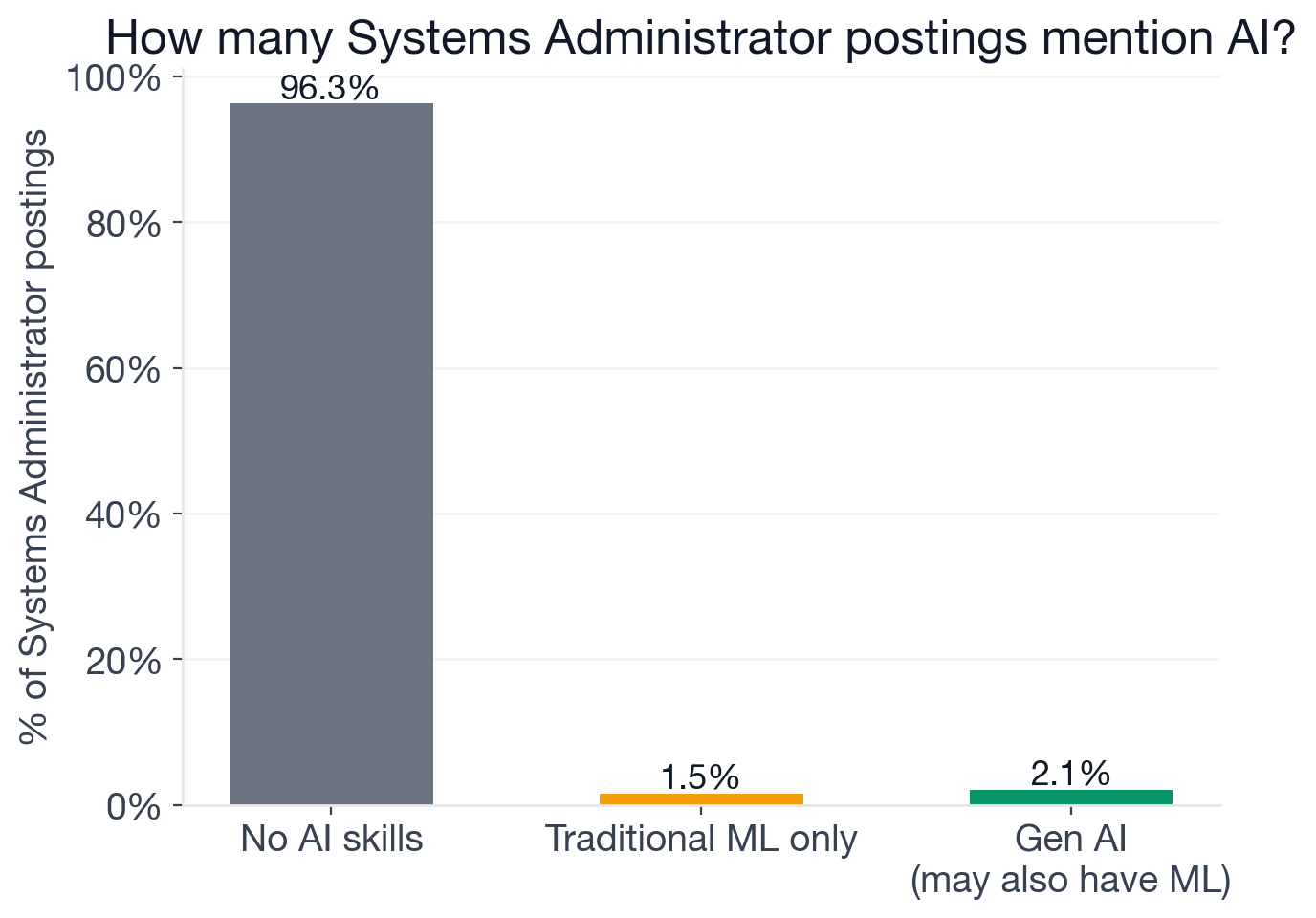
Breakdown of 3,906 Systems Administrator postings by AI skill category. The 0.3% requiring both new-wave and traditional ML skills are counted in both tiers.
Viewed through job postings alone, the shift looks modest. 96.3% of Systems Administrator postings don't explicitly mention any AI skill. The 3.7% that do break into two tiers: 1.8% (71 postings) ask for traditional machine learning or deep learning, a category present in niche sysadmin roles for several years. The genuinely new tier is the 2.1% (83 postings) requiring generative AI tools: AI agents, LLMs, generative AI concepts, ChatGPT, RAG pipelines, or prompt engineering.
Treat those 83 postings as a leading indicator rather than a current-state summary. The composition of that group tells something concrete about where enterprise environments are heading. More than any other new-wave skill, they ask for AI Agents.
That is not what most practitioners would predict. You might expect GitHub Copilot or ChatGPT to dominate, since those are the tools most IT staff actually use. AI Agents leading instead suggests these postings aren't recruiting for tool users; they're recruiting for infrastructure governors: people who will manage the compute, permissions, logging, and reliability of autonomous AI systems running inside the enterprise.
Which AI Skills Show Up in Systems Administrator Postings?
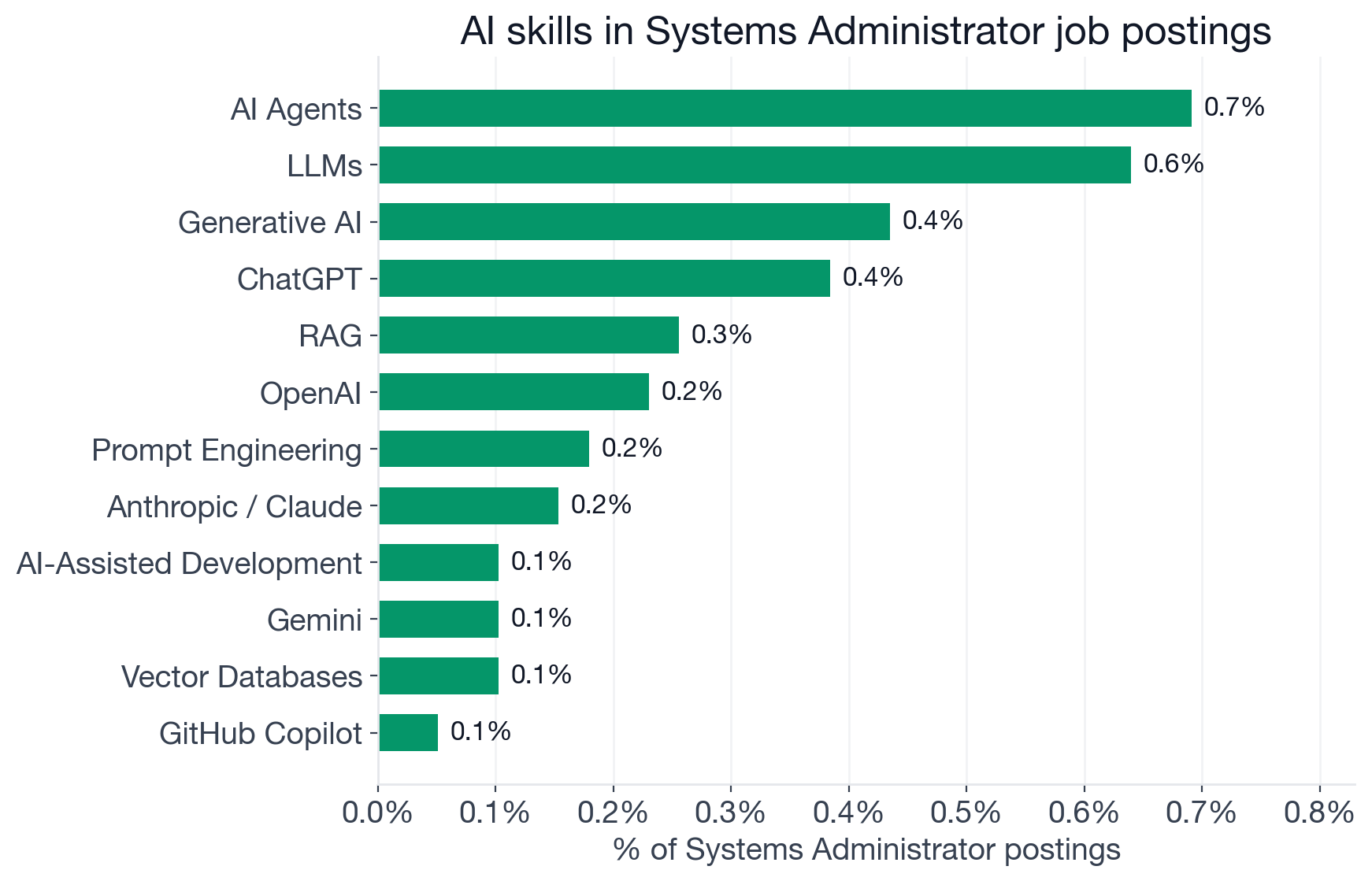
Share of 3,906 Systems Administrator postings that mention each AI skill. Traditional ML and new-wave generative AI skills shown separately.
The ranked list separates into two distinct groups. Traditional ML (Machine Learning at 1.77%, 69 postings; MLOps at 0.20%, 8 postings) reflects roles where sysadmins support data science infrastructure: running GPU clusters, handling the operations side of model deployment. These have been in a small slice of sysadmin postings for several years.
The new-wave list reads differently. At the top:
- AI Agents (0.69%, 27 postings): Deploying, configuring, and governing autonomous AI systems in enterprise environments. Browse AI Agents Systems Administrator postings to see which employers are already recruiting for this layer.
- LLMs (0.64%, 25 postings): Working with large language model deployments, typically as part of enterprise AI integrations or internal developer tooling.
- Generative AI (0.44%, 17 postings): A broader category, often appearing alongside security and compliance requirements for managing generative AI use policies.
- ChatGPT / OpenAI (0.38% / 0.23%, 15 / 9 postings): These tend to appear when the employer explicitly names the tool rather than the category, often for help-desk AI integrations or productivity platform administration.
- RAG (0.26%, 10 postings): Retrieval-Augmented Generation (a technique that feeds enterprise documents into an LLM at query time), where sysadmins manage the vector databases and document pipelines that make enterprise LLM deployments factually accurate.
None of these appear at high individual frequency. But the combination of AI Agents, LLMs, and RAG points to a real infrastructure governance layer forming: enterprises are deploying AI systems that need the same operational discipline as any other production system, and a slice of sysadmin postings is now recruiting for people who can run that infrastructure.
The Layer Postings Don't Capture
The 83 explicit postings are the visible fraction. The ambient AI layer is everywhere else.
ITSM.tools' 2026 research found that 72% of IT professionals are using free AI tools like ChatGPT alongside whatever corporate tooling they have access to. Only 2% of IT organizations report zero AI use. IT operations is already the second-most AI-in-production department across enterprises, with 51% of IT ops teams actively using AI in production, trailing only customer service at 56%.
What does that look like in practice? GitHub Copilot is used for PowerShell and Bash scripting, cutting the time to write a functional provisioning script from hours to minutes. ChatGPT handles incident summaries, change-request drafts, and knowledge-base articles. AI-powered ITSM platforms have moved ticket triage and first-pass classification out of human hands. As GitHub noted in the DevOps context, Copilot's Agent Mode can now manage multi-file infrastructure tasks autonomously, closing a loop that previously required sustained sysadmin attention.
Broader developer surveys confirm the trend. JetBrains' 2026 research found 90% of developers regularly using at least one AI tool at work. The Stack Overflow 2025 Developer Survey puts 51% of professional developers using AI tools daily. The JetBrains and Stack Overflow samples skew toward software developers more than pure operations staff, but the ITSM.tools figures, which survey IT practitioners specifically, confirm the pattern holds in infrastructure roles.
This is the distinction that matters for career decisions: not "does your posting mention AI?" but "are you treating AI tools as a daily work multiplier or as something optional?" The answer to the second question is already the same at nearly every IT shop, regardless of what the job description says.
Does AI Show Up in Salary Data?
Among US postings with disclosed salary data, the median base is $80,987 across 982 Systems Administrator postings. This is US base salary only, excluding equity, bonuses, and sign-on. Total compensation at employers with equity programs is meaningfully higher than these figures reflect.
The honest assessment of the salary data: the US sample of postings requiring new-wave AI skills is 16, below the 25-posting threshold for a statistically reliable median. Publishing a specific US AI premium here would overstate the precision of the data.
The global signal is directional. Across 52 postings globally that mention any AI skill, the median salary is $100,000 versus $77,500 for the 1,179 non-AI postings, a $22,500 gap. That comparison crosses currencies and compensation norms that don't translate cleanly across markets. Still, the direction is consistent with what we see in roles where the AI-skill sample is large enough to measure precisely: infrastructure governance of AI systems demands rarer expertise, and rarer expertise commands a premium. The sysadmin data doesn't yet have enough AI-specific postings with US salary disclosure to put a confident number on it.
Which Sectors and Levels Lead the AI Shift?
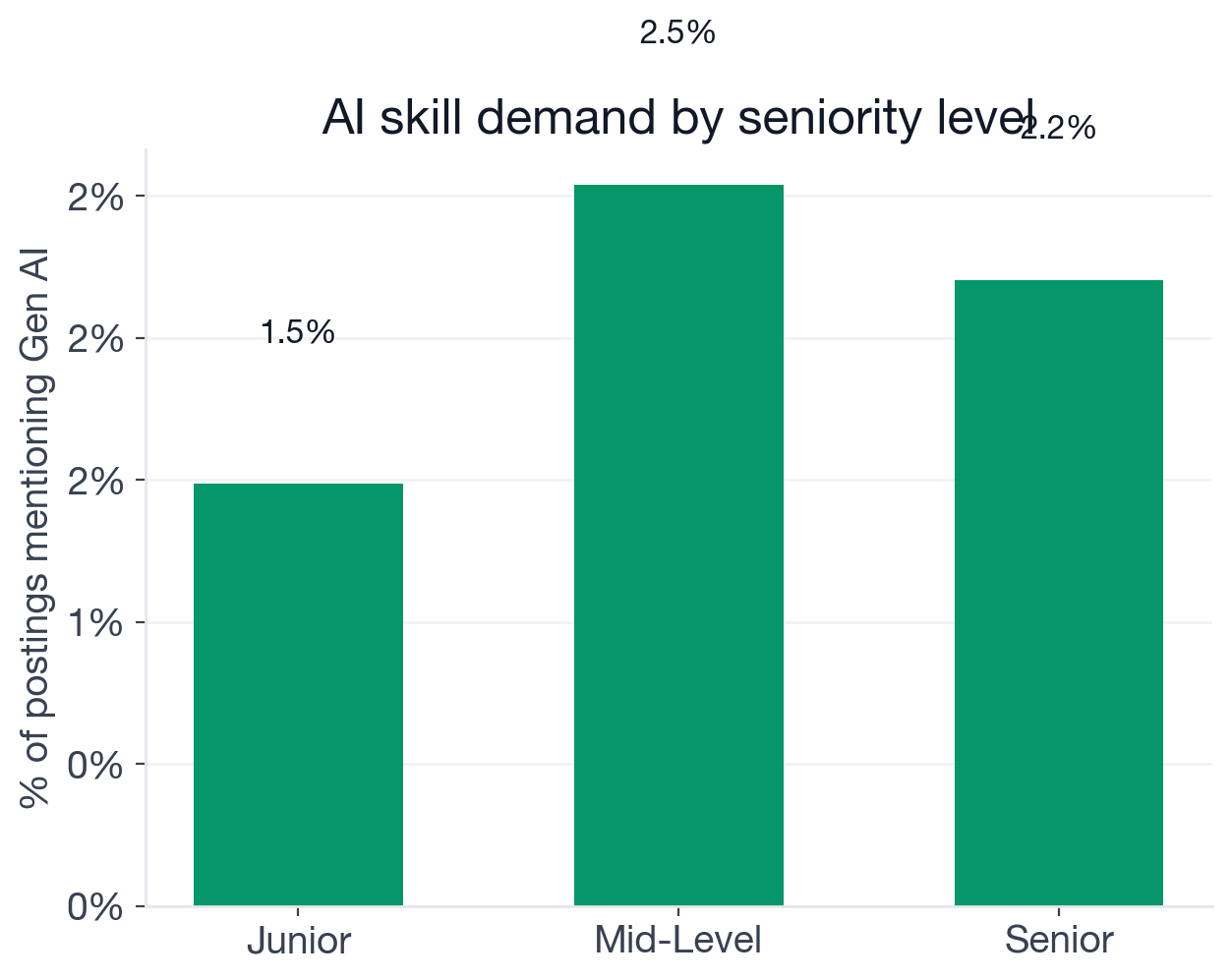
Percentage of postings at each seniority level that include at least one AI skill requirement. Overall seniority mix: senior 66.3%, mid-level 22.2%, junior 5.2%, entry 3.8%, staff 2.6%.
The seniority data holds one quiet surprise: mid-level roles show the highest AI adoption rate at 2.5% (22 of 867 postings), slightly ahead of senior at 2.2% (57 of 2,588). Entry-level shows zero. Staff lags at 1%.
The pattern makes sense when you think about what AI requirements in a sysadmin posting actually mean. They appear when a role has real operational scope: enough autonomy to deploy, configure, and govern AI systems in production. Junior roles aren't typically given that scope. Staff-level roles are often defined by deep specialization rather than breadth. Mid-level and senior are the bands where the "manage AI infrastructure" ask becomes plausible.
The more structurally important split is by industry.
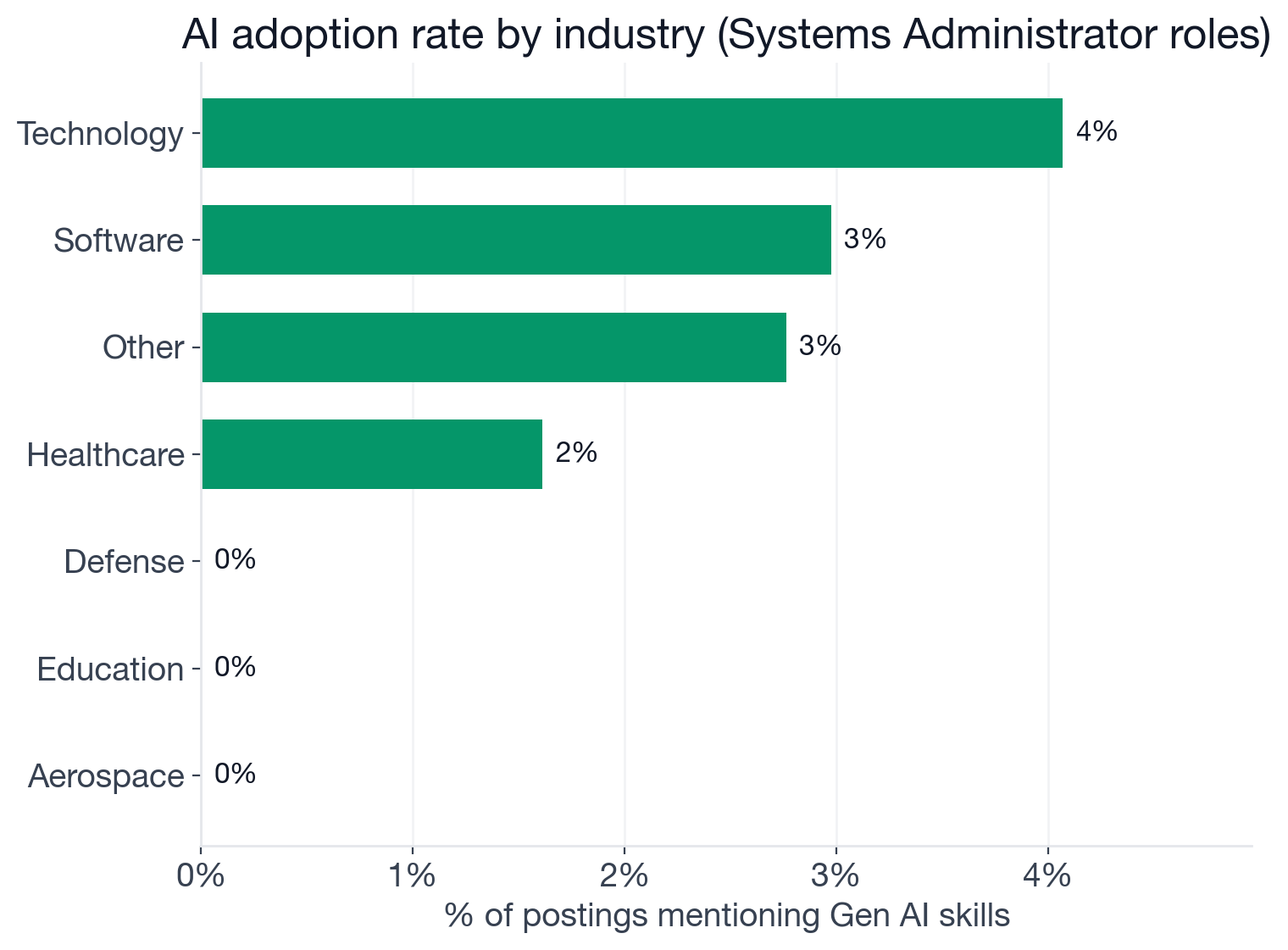
AI adoption rate among Systems Administrator postings by industry sector. Defense (124 postings), education (150 postings), and aerospace (107 postings) each recorded zero AI-explicit postings.
Technology companies lead at 4.1% (12 of 295 postings). Software companies follow at 3.0% (10 of 336). Then three major sysadmin-hiring sectors sit at zero: defense (124 postings, 0%), education (150 postings, 0%), and aerospace (107 postings, 0%).
That zero across 381 postings in three sectors is not a sign that those employers don't use AI. It's a signal about how fast different institutional environments update their job descriptions and purchasing decisions. Defense contractors operate under clearance requirements and procurement cycles that create genuine friction for rapid AI adoption. Educational institutions have different risk tolerances around data governance. Aerospace has safety-critical qualification processes that slow tooling adoption across the board.
If you're choosing between sectors, this split gives you a practical lens. Technology and software companies are where AI-explicit postings are. Defense, education, and aerospace still look very much like 2021 on the surface. The ambient AI layer will reach those sectors too, but the job descriptions won't reflect it for some time yet.
How to Use This in Your 2026 Job Search
The data gives you three distinct decisions to make.
Tool fluency, regardless of what your posting says. With 72% of IT practitioners already using free AI tools and only 2% of organizations reporting zero use, treating GitHub Copilot for scripting or ChatGPT for incident documentation as optional is a real competitive disadvantage. Practice with AI mock interviews that include system administration scenarios: being able to articulate how you use these tools under interview conditions matters as much as actually using them.
Skill positioning for the AI governance tier. If you're targeting mid-level and senior postings at technology or software companies, the skills that define the explicit AI layer (AI Agents, LLMs, RAG, prompt engineering) are what those postings ask for. Use the question bank to drill the infrastructure governance concepts that surface in interviews for these roles: AI agent permission models, LLM deployment reliability, RAG pipeline data security, and how to apply change-management discipline to AI system rollouts.
Sector targeting. Browse active Systems Administrator openings and filter by sector if the direction matters to you. Technology and software companies have measurably more AI-explicit postings right now. Defense, education, and aerospace are the stability choice if you prefer traditional infrastructure work in the near term. Interactive courses on cloud infrastructure and systems design help build the depth that technology-sector sysadmin postings increasingly require, whether or not the posting explicitly mentions AI.
FAQ
Q. What percentage of Systems Administrator job postings require AI skills in 2026?
3.7% of the 3,906 active Systems Administrator postings analyzed for this post mention any AI skill (146 postings). The new-wave generative AI tier is narrower: 2.1%, or 83 postings, explicitly ask for skills like AI agents, LLMs, generative AI, ChatGPT, RAG, or prompt engineering. This low explicit rate does not mean AI is absent from the role: survey data from ITSM.tools shows 72% of IT professionals are already using free AI tools like ChatGPT in their daily work, a layer that most job postings do not capture.
Q. Which AI skills appear most in Systems Administrator job postings?
Among new-wave AI skills, AI Agents leads at 0.69% of postings (27 of 3,906), followed by LLMs at 0.64% (25 postings), Generative AI at 0.44% (17 postings), ChatGPT at 0.38% (15 postings), and RAG at 0.26% (10 postings). The pattern reflects two different hiring needs: roles that require infrastructure governance of AI systems (AI Agents, LLMs, RAG) and roles where the employer names a specific productivity tool (ChatGPT, OpenAI). Machine Learning, a traditional pre-generative AI category, appears more broadly at 1.77% (69 postings).
Q. What is the median Systems Administrator salary in 2026?
The median US base salary across 982 Systems Administrator postings with disclosed salary data is $80,987. That figure is US-only base salary, excluding equity, bonuses, and sign-on payments. The sample of US postings that also require new-wave AI skills is too small (n=16) to produce a statistically reliable separate median, but the global signal across 52 AI-skill postings points directionally to a meaningful premium over the non-AI baseline.
Q. How is AI actually changing what Systems Administrators do day to day?
Most of the change is in the ambient, unannounced layer: AI-powered ITSM platforms now handle ticket classification and first-pass resolution; GitHub Copilot accelerates PowerShell and Bash scripting; ChatGPT is used for incident diagnosis, documentation drafts, and change-request summaries. ITSM.tools' 2026 survey found only 2% of IT organizations report zero AI use. The explicit-requirement layer, visible in job postings, reflects a different shift: a growing subset of sysadmin roles now involves deploying and governing AI agents in enterprise infrastructure, integrating LLMs into business platforms, and managing the compute and network demands of AI workloads.
Q. Which industry sectors are driving AI adoption in Systems Administrator hiring?
Technology companies lead explicit AI adoption among Systems Administrator postings at 4.1% (12 of 295 postings), followed by software companies at 3.0% (10 of 336). Notably, three significant sysadmin-hiring sectors showed 0% explicit AI adoption: defense, education, and aerospace. This does not mean those employers avoid AI entirely; it likely reflects longer procurement cycles, stricter regulatory constraints, and slower job-description refresh rates in institutional environments.
Q. Do entry-level Systems Administrator roles require AI skills?
Among the 149 entry-level Systems Administrator postings in this analysis, none explicitly mention AI skills. AI-explicit requirements appear at mid-level (2.5% of mid-level postings, 22 of 867) and senior level (2.2%, 57 of 2,588). This reflects a logical pattern: explicit AI requirements appear in roles that have scope to govern, integrate, or manage AI systems, not in initial-level roles focused on foundational operations.
What This Means for Your Next Move
The Systems Administrator role in 2026 sits at an unusual inflection point: explicit AI requirements are low, ambient AI usage is nearly universal, and the institutional employers who dominate sysadmin hiring have barely begun to reflect either layer in their job descriptions. Industry analysts widely project that agentic AI deployment in enterprise IT infrastructure will become standard practice within a few years, a forecast about the scope of what the role will need to govern, not just use. The gap between the job postings and the practice is closing, even if the postings haven't caught up yet. Building AI governance skills now, while most candidates are waiting for a posting to ask for them, is the early-mover window.
Topics
Ready to practice?
Put what you've learned into practice with AI mock interviews and structured preparation guides.